The short answer
No single body checks every vegan or cruelty-free claim in the UK. A claim on a pack can rest on an independent audit, a signed statement, a registered trademark, or only the brand's own word, and they all look alike on the shelf. The law sets a floor: animal testing of cosmetics has been banned in the UK since 1998, and misleading claims can be fined.
This guide sets out who checks what, how each check works, and what a claim can and can't tell you.
Who checks what, at a glance
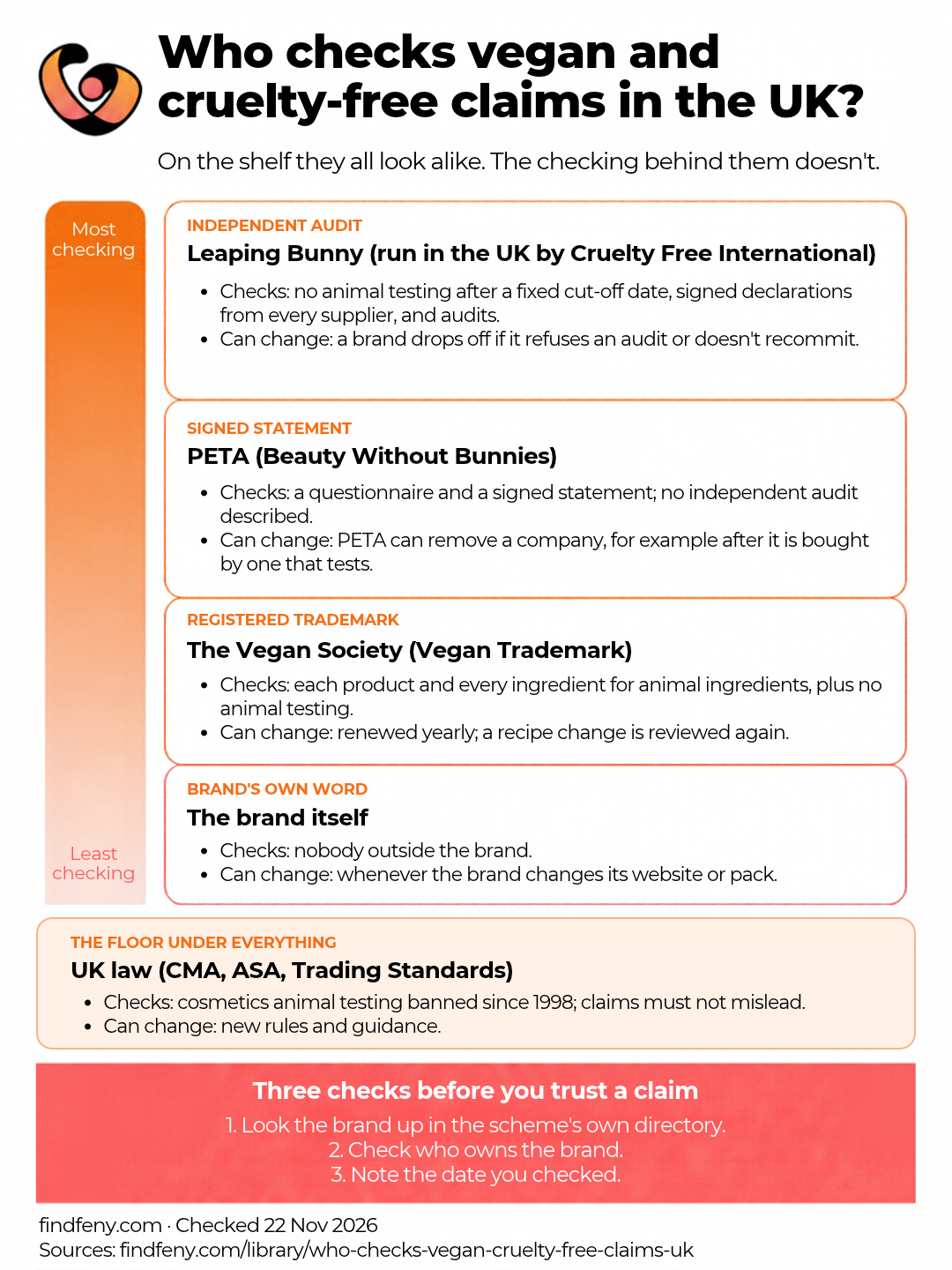
From the most checking behind a claim to the least.
| Level | Who | What they check | How it can change |
|---|---|---|---|
| Independent audit | Leaping Bunny (run by Cruelty Free International in the UK) | No animal testing after a fixed cut-off date, on ingredients, formulations and finished products; signed declarations from every supplier; an audit that traces products back to those declarations | A brand drops off if it refuses an audit or doesn't recommit |
| Signed statement | PETA (Beauty Without Bunnies) | A questionnaire and a signed statement that the company and its ingredient suppliers don't test on animals; no independent audit described | PETA can remove a company, for example after it is bought by one that tests |
| Registered vegan trademark | The Vegan Society (Vegan Trademark) | Each product and all its ingredients: no animal ingredients or by-products, no animal testing by the company or on its behalf | Renewed yearly; a changed recipe must be reviewed again |
| Brand's own word | The brand | Nobody outside the brand | Whenever the brand changes its website or pack |
| Legal floor | UK law, enforced by the CMA, the ASA and Trading Standards | Cosmetics and their ingredients can't be tested on animals in the UK for safety; claims must not mislead | New rules and guidance |
Find Feny records which level each brand's claim rests on, with the source and the date we checked, and watches for changes.
Each checker in plain words
Leaping Bunny
The strictest of the cruelty-free schemes. A brand sets a fixed cut-off date, after which no animal testing can happen on its ingredients, formulations or finished products. It collects signed declarations from every supplier and manufacturer, and may only buy from suppliers whose declarations are on file. An auditor picks products at random, asks for proof of purchase and checks each supplier has a declaration. Certifying is free; the logo is a paid licence. In the UK and Europe the scheme is run by Cruelty Free International. (Source: Leaping Bunny company FAQ)
PETA
A company fills in a short questionnaire and signs a statement of assurance that it doesn't conduct, commission or pay for animal tests, and that its ingredient suppliers don't either. PETA's FAQ describes no independent audit. Listing is free; the logo is a one-off fee. PETA updates its list often and can remove a company, for example when a company that tests buys it. (Source: PETA Beauty Without Bunnies FAQ)
The Vegan Society
The Vegan Trademark is registered product by product. The Society's team checks each product and all its ingredients: no animal products, by-products or derivatives, and no animal testing done by the company or on its behalf. Brands must keep cross-contamination as low as practicable. The trademark is renewed yearly, and a change to a registered product's recipe must be reviewed. (Source: Vegan Trademark Standards)
The brand itself
"Cruelty-free", "vegan" or "we never test on animals" on a pack or website, with no scheme behind it. Some brands genuinely don't test but haven't done a scheme's supplier paperwork. Nobody outside the brand has checked the claim, and it can change without notice.
What the law says
- Testing cosmetics on animals: banned in the UK since 1998 for the safety of cosmetics and their ingredients. Since May 2023 the Home Office grants no new licences to test chemicals used only in cosmetics. Ingredients that also have other uses, such as in cleaning products, sit under chemicals law and can still be tested. (Sources: written statement, 17 May 2023; PETA UK)
- Misleading claims: since 6 April 2025 the Competition and Markets Authority can fine a business directly, up to 10% of its group's annual turnover, for misleading consumers. (Source: Reed Smith)
- Adverts: the Committee of Advertising Practice says a brand claiming it doesn't test on animals should not have tested the product or its ingredients, and should not buy ingredients from suppliers who did. (Source: ASA advice, 16 September 2025)
- What no law requires: there's no legal definition of "vegan" for products, and no brand has to join a scheme or show its evidence on the pack.
Because of the ban, "not tested on animals" on a UK cosmetic mostly repeats the law. The real questions are about suppliers, parent companies and other markets.
What a claim on a pack can and can't tell you
| On the pack | What it tells you | What it doesn't |
|---|---|---|
| A certifier's name or logo | That the brand was approved by that scheme at some point | Whether it's still listed today; check the scheme's own directory |
| "Vegan" | The brand says the product has no animal ingredients | Who checked it, unless a trademark is named; whether the brand's other products are vegan |
| "Cruelty-free" or "not tested on animals" | The brand says no animal testing | Anything about suppliers or the parent company, unless a scheme is named |
| "Suitable for vegetarians" | No meat or fish | It can still contain milk, eggs or honey |
Three checks that catch most surprises:
- Look the brand up in the scheme's own directory, not just the pack. Listings lapse, and a pack printed last year won't show it.
- Check who owns the brand. A cruelty-free brand can belong to a parent company with a different policy.
- Note the date you checked. Statuses change, so a check without a date is hard to rely on.
Where Find Feny fits
Find Feny doesn't certify anyone. For each brand, it records which level the claim rests on (certified by a scheme, the brand's statement only, a claim the certifier doesn't confirm, or no listing found), with the source and the date checked. Brands can reply with corrections, and we re-check and log what changes.
- Shoppers: look up a brand on findfeny.com/brands, or get changes first in the Saturday Food Brief.
- Shops and wholesalers: we'll watch 10 of your brands for free and email you if a status changes. See how it works
Sources
All read on 22 November 2026 unless dated otherwise.
- Leaping Bunny: company FAQ (read 20 November 2026)
- PETA: Beauty Without Bunnies FAQ (read 20 November 2026)
- The Vegan Society: Vegan Trademark Standards
- UK Parliament written statement, 17 May 2023
- PETA UK: ingredients used only in cosmetics
- ASA: animal testing and cosmetics (advice dated 16 September 2025)
- Reed Smith: the CMA's enforcement powers under the DMCC Act
Want to know where your brands sit? We'll check 10 for free.
Get your free check